
Created: 1st July, 2026

Gareth joined Barker in 2024, based in our Essex head office.
He is a Chartered Civil Engineer with more than 20-years’ experience in Civil Engineering solutions & has lead both Civil & Structural Engineering teams on projects from conception to project delivery, with values exceeding a billion pounds both nationally and internationally.
He holds a deep understanding of Infrastructure Engineering, focused on a value led design ethos to complex situations, which has allowed the positive integration of infrastructure into coordinated design masterplans across all sectors.
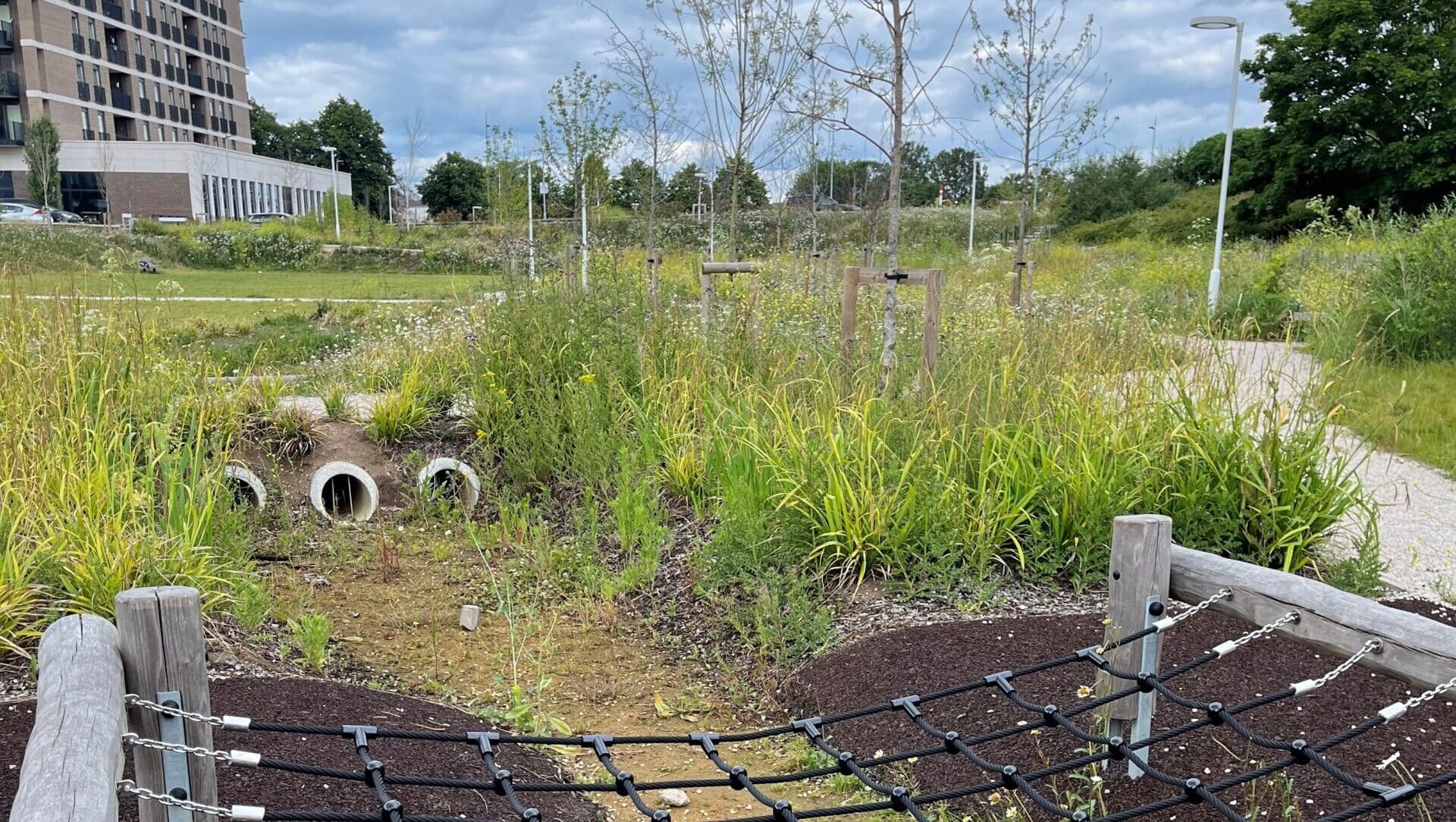
Sustainable Drainage Systems (SuDS) are now a fundamental component of developments, supporting flood resilience, biodiversity, and wider environmental objectives.
However, their long-term success is not defined at the point of design or completion of construction, but by the effectiveness of ongoing maintenance, ownership clarity, and operational management. Industry guidance consistently highlights that even well-designed systems can underperform if maintenance is not considered from the outset, whereas simple, well-maintained systems can continue to operate effectively for decades.
SuDS in schools, for example, are typically integrated into multifunctional environments, including playgrounds, sports facilities, and landscaped areas. While this approach enhances amenity and educational value, it also introduces complexity when it comes to balancing drainage performance with day-to-day usability.
Common risks include unclear adoption and ownership responsibilities; constrained access for maintenance activities; and an underestimation of routine requirements such as sediment management, vegetation control, and inspection regimes. If these factors are not addressed early, systems can become difficult to manage in live schools, increasing the likelihood of performance issues and unplanned interventions.
A key principle reinforced within the SuDS Manual is that maintenance should be treated as a core design consideration rather than an operational afterthought. Design decisions relating to layout, component selection, and detailing directly influence how systems can be accessed, inspected, and maintained over time.
Effective schemes are those that prioritise accessibility, simplicity, and integration with standard facilities management practices, ensuring that maintenance activities can be undertaken safely and efficiently without disrupting the wider use of the site.
To mitigate these risks, a proactive approach is required from the earliest phases of the project. This includes establishing clear ownership and adoption strategies, whether through local authority or water company adoption, or through private management arrangements, alongside the preparation of robust maintenance schedules that are carefully embedded within the drainage strategy.
Alignment with the operational and educational use of the site is also critical, ensuring that SuDS features contribute positively to the overall environment while remaining functional and manageable in the long term.
From a lifecycle perspective, properly maintained SuDS (that have also been designed to National Standards) can offer significant long-term value. By relying on natural processes and relatively simple maintenance interventions, they can reduce dependence on complex infrastructure and minimise the risk of costly remediation works.
This not only protects drainage performance but also ensures that wider benefits, including biodiversity, amenity, and educational outcomes, are sustained over time.
Ultimately, the performance and resilience of SuDS infrastructure are directly linked to how effectively maintenance risks are understood and addressed throughout design, construction, and ongoing operation.
For education developments in particular, where operational simplicity, safety, and cost certainty are critical, this requires a coordinated and informed approach.
Barker supports clients in identifying and managing these risks through structured design review, technical validation, and long-term strategy development. If you have any concerns regarding the performance, maintenance, or adoption of SuDS infrastructure, speak to our team, who would be happy to provide further advice and support.