

Created: 15th May, 2026

Robert joined Barker in 2002 and is a Partner based in our Braintree office. A Fellow of the Royal Institution of Chartered Surveyors, he has over 20 years’ experience of all core building surveying services and provides strategic estates advice to key accounts in the education, commercial, ecclesiastical and public sectors.
An education specialist, he provides the following services: estates and energy strategy, asset management planning, project management and capital funding applications.
Robert works closely with clients to plan and implement energy efficiency and sustainability strategies to save money, reduce carbon emissions and meet ESG objectives.
As a RICS Certified Historic Buildings Professional he provides conservation consultancy for clients with listed and historic buildings.
Robert is an experienced APC Assessor and Chairman and is also an external examiner for Anglia Ruskin University
As a Partner Robert leads the Business Development and Marketing function at Barker, builds relationships with key sector bodies and helps steer the strategic growth of the company.
Email: rgould@barker-associates.co.uk
Tel: 01279 648057
In February 2026, the Department for Education (DfE) published its landmark Education Estates Strategy: A Decade of National Renewal, a 10‑year plan backed by £38 billion to modernise, decarbonise, and future‑proof England’s 22,200 school and college buildings.
At its core, the strategy shifts schools away from reactive maintenance and towards long‑term, proactive estate management, with energy efficiency and carbon reduction embedded throughout.
For school leaders, estates teams, and Trust boards, this strategy is more than a policy document. It’s a roadmap for reducing energy consumption, cutting operational costs, and preparing buildings for a Net Zero future. It’s underpinned by the Manage Your Education Estate (MYEE) service, which brings management resources, estate condition data, funding allocations, funding information and policy updates into one portal for Responsible Bodies.
The DfE commissioned Sustainability Support for Education platform also provides quality-assured resources, tools, and recommended actions to help schools progress their sustainability journey.
We have already covered the key takeaways from the new framework in depth and have addressed some immediate concerns from school business leaders. But now, let’s take a closer look at the most significant energy-related elements of the strategy and what they might mean in practice.
One of the most transformative elements of the strategy is the introduction of a £710 million Renewal and Retrofit Programme, designed to improve the condition and climate resilience of existing buildings.
Pilot regions from April 2026 include Yorkshire and the Humber, East Midlands, and the South East, with a national rollout expected by 2029.
For schools, this means:
The strategy encourages schools to consider “investable projects” – i.e., interventions that deliver strong carbon savings and financial payback. For example:
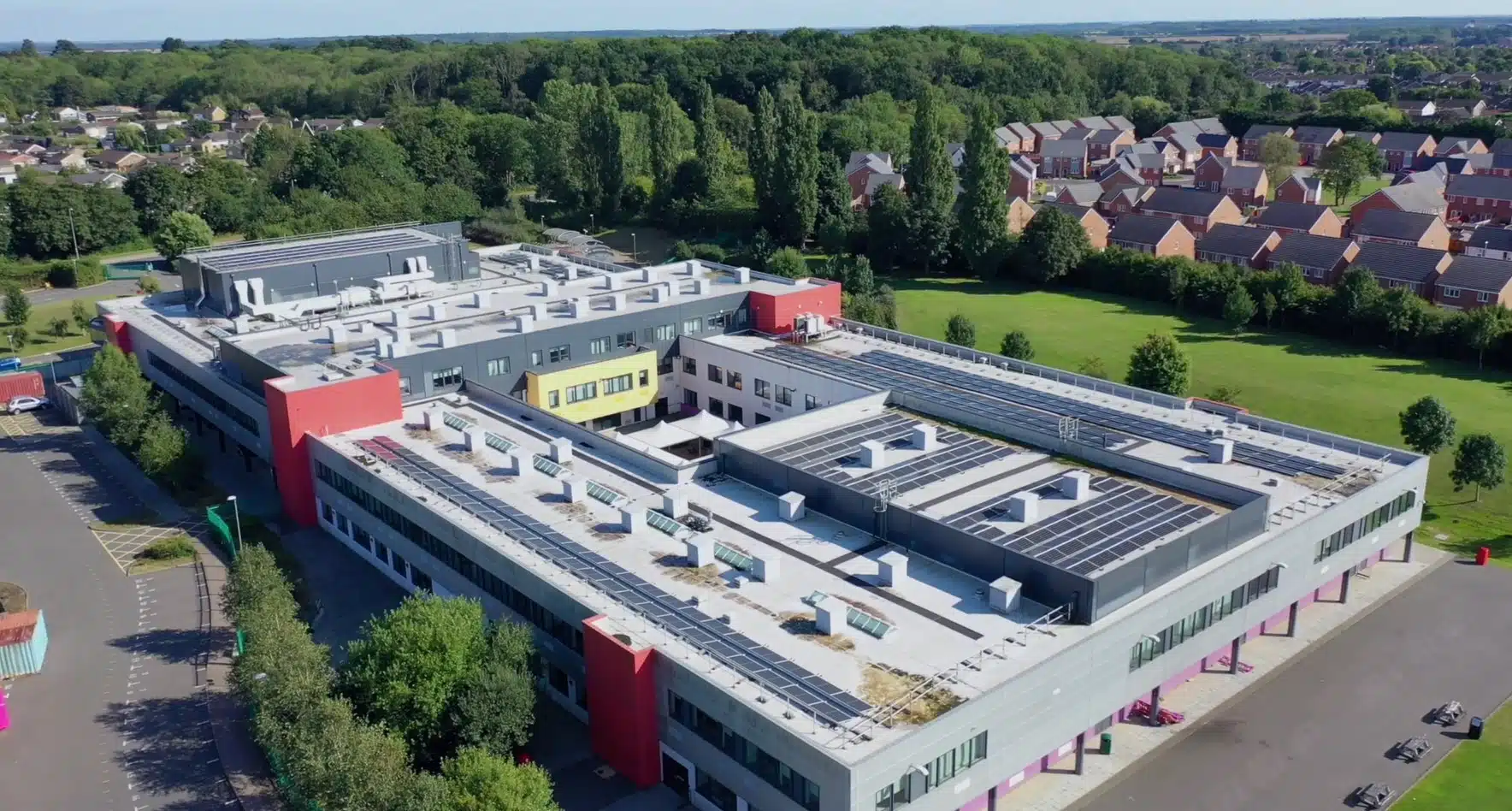
With 55 million m² of school roof space available nationally, the DfE encourages widespread solar deployment to cut grid reliance and generate long‑term savings.
Real-world deployment generally shows that replacing fluorescent lighting with LEDs, paired with daylight and occupancy sensors, can reduce lighting energy use by 80% – 90%.
Modern BMS solutions help schools optimise heating, ventilation, and cooling, reducing waste and improving comfort.
Smart plug sockets and automated controls help reduce phantom loads and improve monitoring.
The strategy makes behavioural change a formal expectation:
All schools must develop a Climate Action Plan, including emissions measurement and energy-saving behaviours.
Reducing heating setpoints by 1°C can save 5–10% on heating bills. Aligning heating settings with operating hours and reducing out-of-hours consumption.
Insulating exposed pipes can reduce heat loss by 50–70%, improving boiler efficiency.
The DfE now expects every school to nominate a Sustainability Lead, a requirement embedded into the updated DfE Estate Management Standards. In practice, this means each school, academy, or trust must have a named staff member who is responsible for coordinating sustainability work.
To help them build their confidence and expertise, they will have access to DfE-funded resources, templates, and guidance, including clear leadership structures that will ensure sustainability isn’t an “extra job” but part of the strategic decision-making process.
Where new buildings are required, the Education Estates Strategy promotes off-site modular construction, which offers:
MMC aligns with the strategy’s emphasis on resilience, efficiency, and long-term value.
A major structural change is the introduction of Manage Your Education Estate (MYEE), a digital hub bringing together estate data, guidance, and compliance tools.
This data-driven approach ensures schools can plan energy upgrades strategically and demonstrate compliance with the School Estate Management Standards.
Ultimately, the Education Estates Strategy is here to accelerate education providers’ progress towards Net Zero.
The DfE’s 2026 strategy represents the most significant shift in school estate management in over a decade. With clear expectations and major funding streams, schools now have both the mandate and the support to reduce energy consumption through practical changes and actionable steps, many of which can be achieved by organisations of any size and scale.
For tailored guidance on how to adjust your estate management strategy in 2026, or to speak to our energy efficiency consultants about how we can assist you in meeting your sustainability goals.